> ## Documentation Index
> Fetch the complete documentation index at: https://docs.streambuild.dev/llms.txt
> Use this file to discover all available pages before exploring further.
# stb dev
> Serve the local StreamBuild UI for one project and target.
Compile a project, connect to its selected ClickHouse target, and serve the packaged web UI and JSON
API until interrupted:
```bash theme={null}
stb dev
stb dev --project-dir examples/orders_demo
stb dev --ui-host 127.0.0.1 --ui-port 8000
```
Open `http://127.0.0.1:8000` by default. `stb dev` accepts the normal project, target, variables, and
ClickHouse connection overrides in addition to:
| Option | Purpose |
| ----------------- | --------------------------------------- |
| `--ui-host VALUE` | Bind interface; defaults to `127.0.0.1` |
| `--ui-port VALUE` | Bind port; defaults to `8000` |
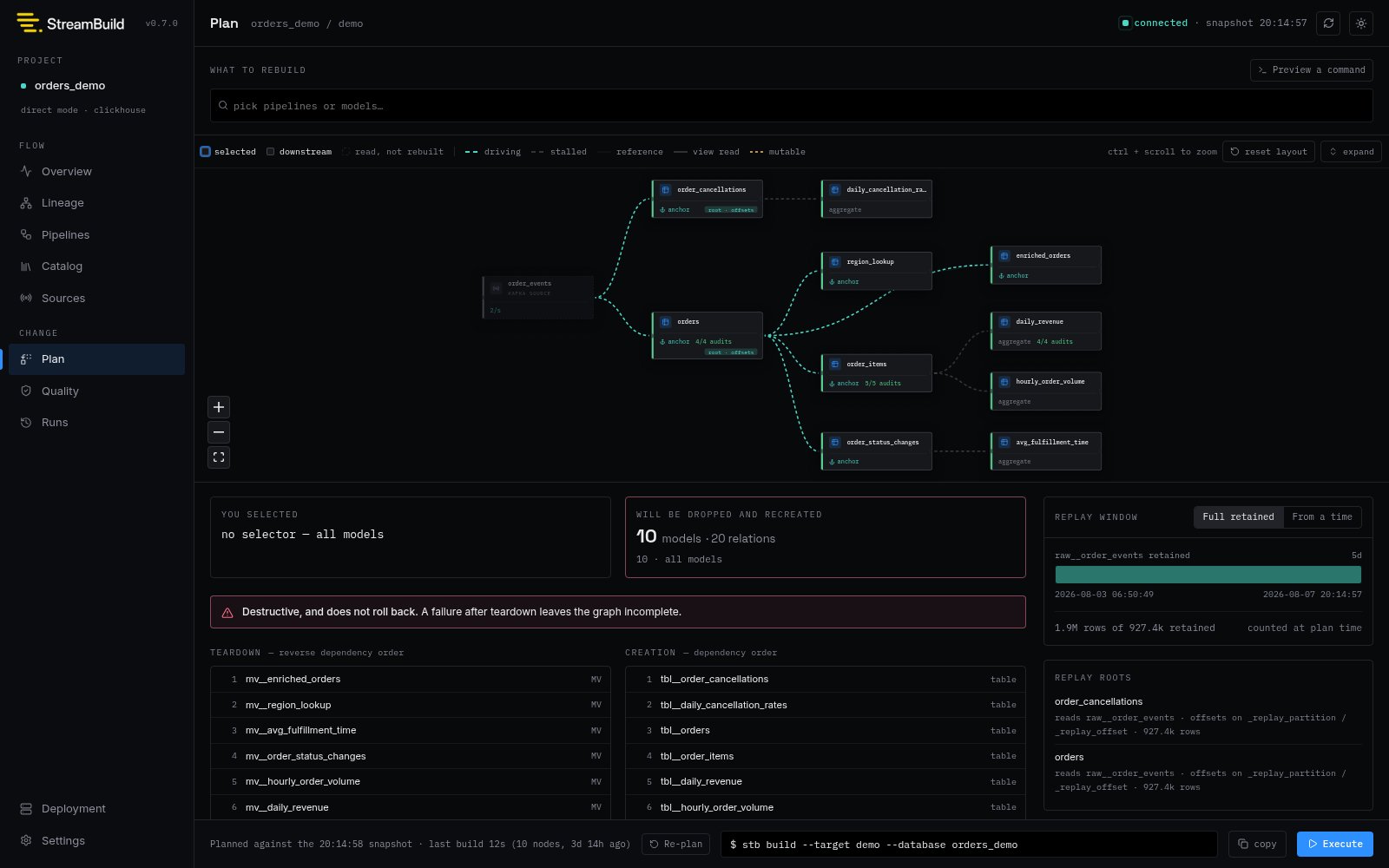
The UI combines authored definitions with live warehouse state. Use it to inspect ingestion,
freshness, lineage, pipelines, sources, catalog relations, deployment state, quality results, and
durable run history. For direct-mode projects, the Plan view previews destructive downstream
closures and can launch the same `stb build --auto-approve --events` execution path with the resolved
project context.
## Ingestion metrics
The Sources views keep two different operational signals separate:
* **Kafka lag** is a message count: the broker high-water offset minus the effective consumer
group's committed offset, summed across partitions.
* **Last arrival** is elapsed time since the newest `_replay_landed_at` value in the ClickHouse
landing table.
Kafka lag is read from Kafka metadata without joining or consuming from the group. Partition detail
shows the landed, committed, and broker-end offsets alongside per-partition lag. The consumer group
is scoped to the selected target database, matching the group rendered into the ClickHouse Kafka
table. If broker metadata or a required committed offset is unavailable, the UI reports Kafka lag as
unavailable; it never substitutes last-arrival age.
Metadata reads are cached and refreshed outside the `/api/state` request path, so a first load may
briefly show unavailable while the initial read completes.
 ## Runs and cancellation
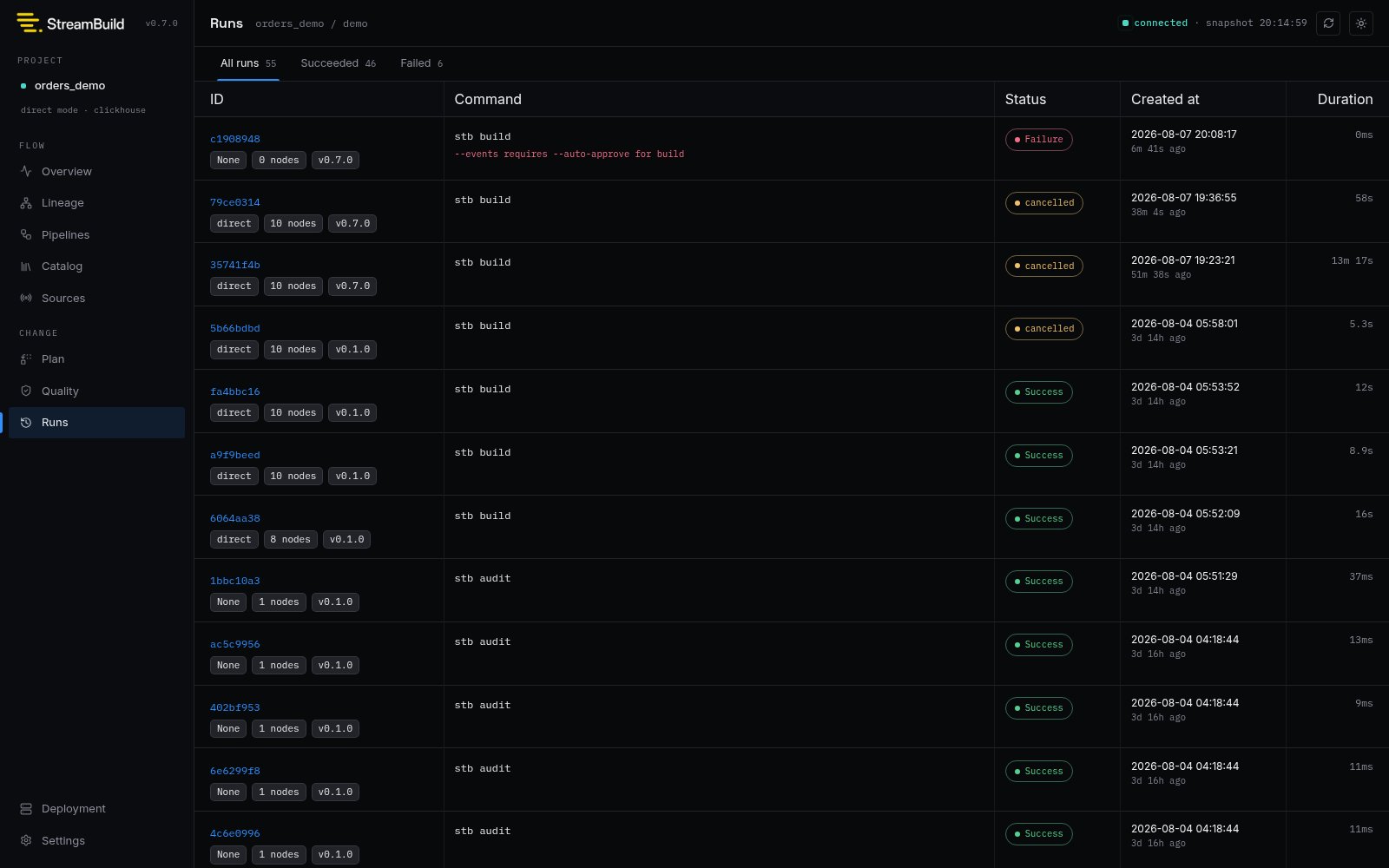
Builds emit durable statement events and a heartbeat every 10 seconds. Runs without a terminal fact
appear as `running`, then `unresponsive` after 45 seconds without a signal, and `presumed failed`
after 10 minutes. These are derived display states, not persisted outcomes, and can reverse when a
later heartbeat or terminal event arrives.
## Runs and cancellation
Builds emit durable statement events and a heartbeat every 10 seconds. Runs without a terminal fact
appear as `running`, then `unresponsive` after 45 seconds without a signal, and `presumed failed`
after 10 minutes. These are derived display states, not persisted outcomes, and can reverse when a
later heartbeat or terminal event arrives.
 The dev server can gracefully cancel only the build child process it launched. If graceful
cancellation does not finish, the UI can force-stop that owned child. Builds started in another
terminal and orphaned runs remain visible but cannot be signalled by the current server. Recovery is
always a fresh `stb build` invocation, never resume.
`stb dev` is a local development surface, not a multi-user control plane. Keep the default loopback
binding unless you intentionally provide network access controls.
The dev server can gracefully cancel only the build child process it launched. If graceful
cancellation does not finish, the UI can force-stop that owned child. Builds started in another
terminal and orphaned runs remain visible but cannot be signalled by the current server. Recovery is
always a fresh `stb build` invocation, never resume.
`stb dev` is a local development surface, not a multi-user control plane. Keep the default loopback
binding unless you intentionally provide network access controls.